Who turns up
A construction background, then two cameras pointed at your roof
Why this ended up being the job
The background is construction rather than photography, which turns out to matter more than it sounds for tracing a leak specifically. Knowing why a valley silts up on one elevation and not another, or what a lifted flashing at a stack actually leads to a metre downslope, is the difference between a pair of interesting-looking pictures and a report that tells a roofer where to start.
The recurring problem, working alongside roofers on Hembury Contracting jobs, was always the same one: a leak that everybody agreed was real and nobody could agree on the source of. Two roofers, two opinions, and a homeowner in the middle deciding who to believe. A thermal camera flown alongside the ordinary one gave that argument something to point at instead of guess about.
Plenty of drone operators can fly a thermal camera. Fewer have stood on enough roofs to know that a warm patch by a flue is not automatically a leak, or that a valley reading cold is sometimes just shaded rather than wet. Reading the two images together against what is actually true about how roofs fail is most of the value in the report.
Everything is flown from Exeter, which puts most of Devon inside an hour. The South West is the patch because it is home, and because the roofs here, slate and lead more than most parts of the country, hide a leak's real path better than almost anything else you could build a roof from.
On the record
Registrations, kit and cover
CAA registered
Operator ID and Flyer ID held, plus the A2 Certificate of Competency. Every trace is planned to the rules that apply to the site, and the paperwork is available before the visit if your agent, insurer or a managing agent wants it.
Radiometric thermal
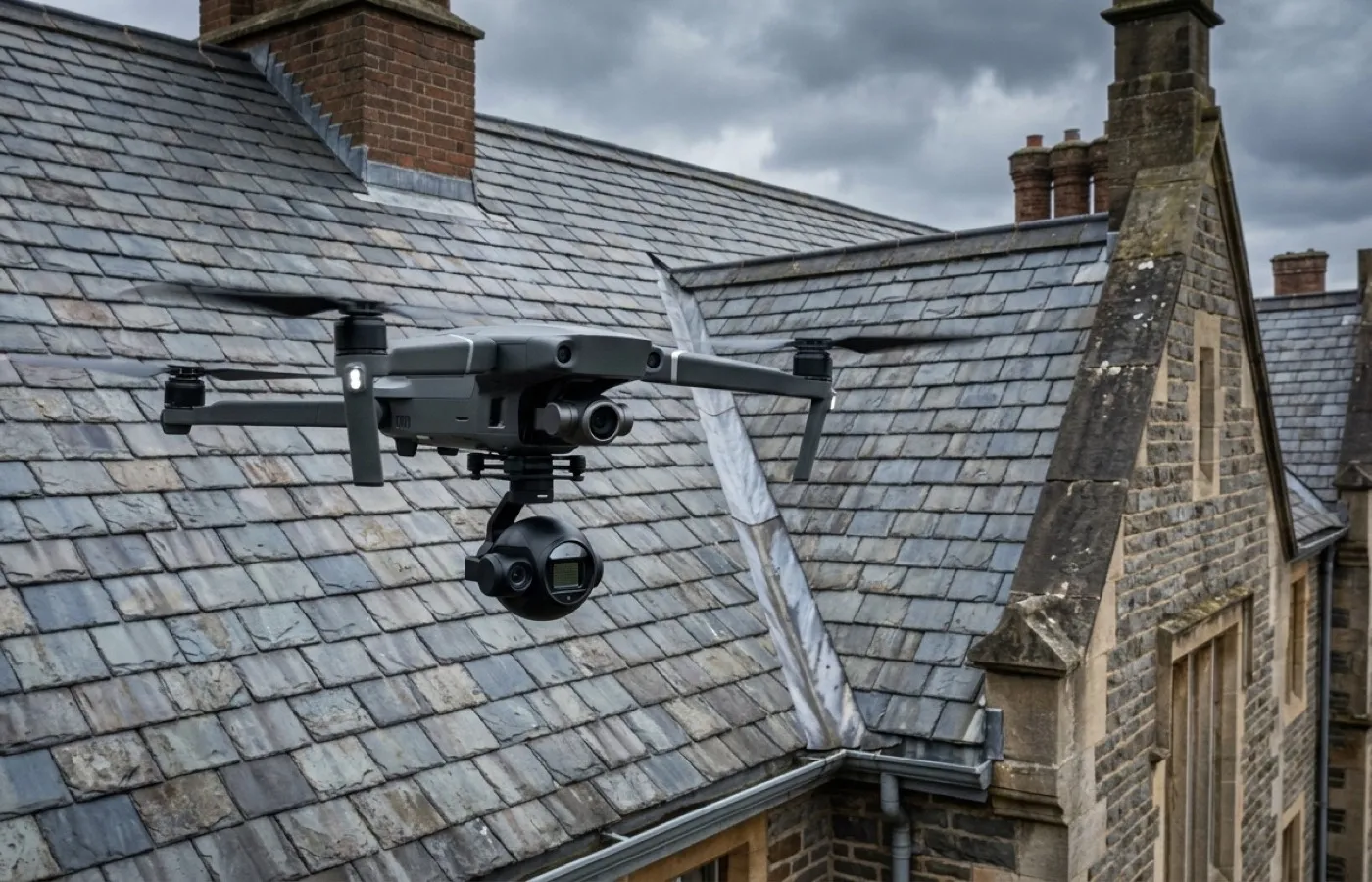
A DJI Mavic 2 Enterprise Advanced carrying a 640 by 512 thermal camera. Water and the material around it hold and release heat differently to a dry roof, which is how a leak gets traced back towards its entry point rather than guessed at from a ceiling stain.
100 megapixel camera
A DJI Mavic 4 Pro with a Hasselblad camera and 6K video, flown alongside the thermal pass. The resolution means a candidate entry point can be shown close up, from a safe standoff distance, without the image falling apart when your roofer zooms in.
Insured with Coverdrone
Full commercial cover for the operation. Certificates go to letting agents, managing agents and insurers as a matter of course, without anyone having to chase for them.
DJI Mavic 4 Pro
100 megapixel Hasselblad camera and 6K video. The visual pass, close enough to resolve a single displaced slate or a hairline crack in a flashing without leaning anything on the building.
DJI Mavic 2 Enterprise Advanced
640 by 512 radiometric thermal camera alongside the visual one. Water holds and releases heat differently to the dry material around it, so a wet patch under a covering can show as a temperature difference before it ever shows as a stain.
How we work
Three things this business will not do
Claim a finding that is not there
Where the thermal and visual evidence points clearly at an entry point, the report says so. Where it is ambiguous, or points somewhere other than the roof entirely, the report says that instead, because a confident wrong answer is worse than a plainly stated uncertain one.
Claim to see through several layers
A thermal camera reads the surface temperature of what it can see. It does not see through insulation, boarding or multiple roof layers, and the report says what could not be assessed rather than quietly leaving it out.
Fly a job that will not work
Wrong wind, wrong light, actual rain: the trace moves. A flight taken in poor conditions produces imagery that cannot carry a decision, and charging for that would be worse than rescheduling.
Find the entry point first
Book a leak trace with Roof Leak Detection
Tell us the address and what the leak is doing. Sam Hembury will come back with a fixed price and the next available slot.