Roof Leak Detection
Leak Trace
A visual pass and a radiometric thermal pass over the same roof, compared, so the entry point can be narrowed down before anyone strips a covering to go looking for it.
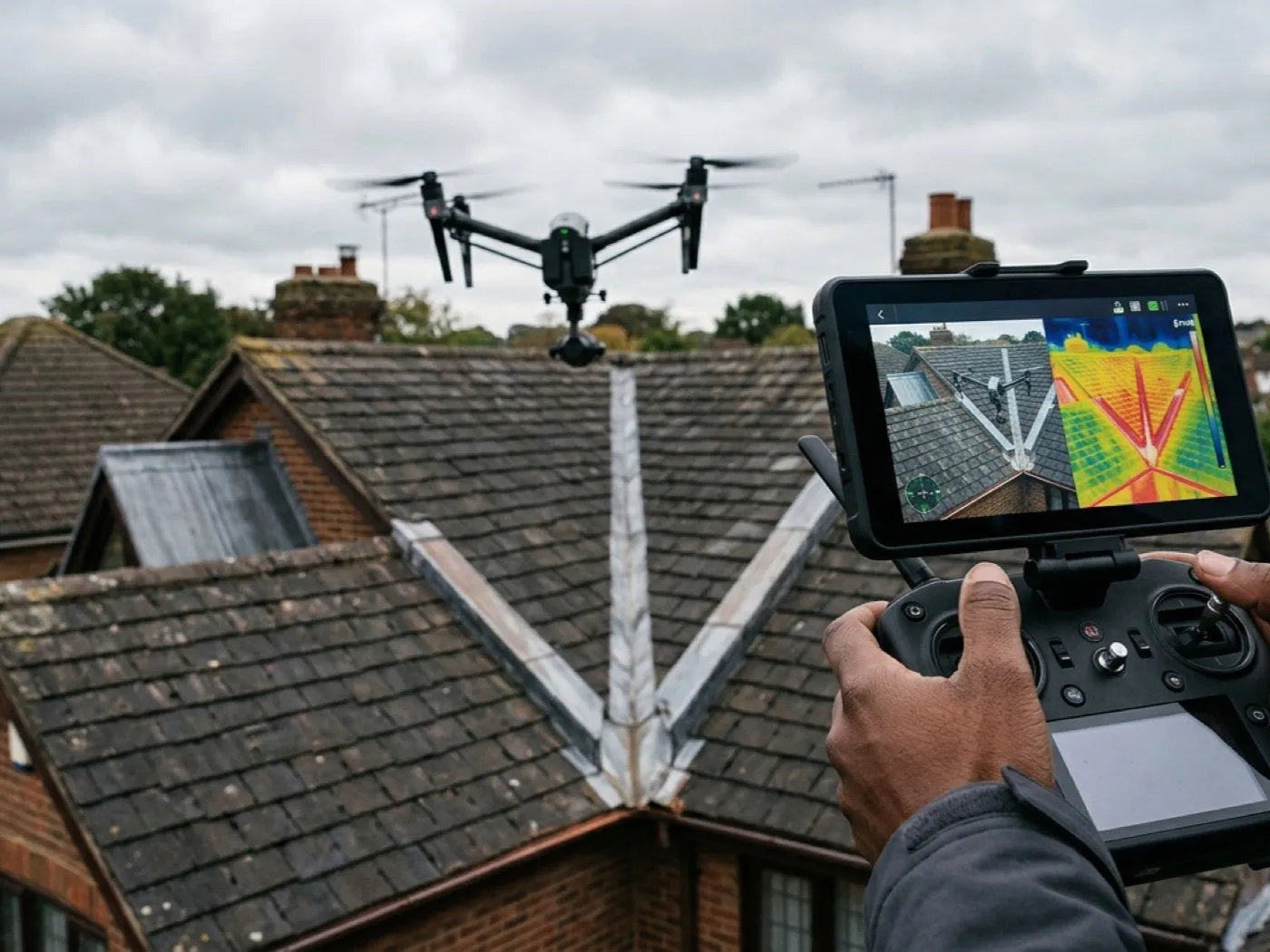
This is the survey most people book. Water has turned up somewhere it should not, usually as a stain on a ceiling or a damp patch on a wall, and nobody can say with any confidence where it is actually getting in. Water travels sideways under a covering before it ever shows itself inside, so the stain and the entry point are very often nowhere near each other.
That is normally where the guessing starts. One roofer thinks it is the chimney flashing, another thinks it is the valley, and the only way anybody has traditionally settled it is to start lifting tiles or slates and hope the leak is under the first one they try.
A flown trace looks at the whole roof from above with an ordinary camera, then again with a thermal one, and puts the two pictures next to each other. A wet patch under a covering often holds and loses heat differently to the dry material around it, which is a second source of evidence beyond where the stain happens to be inside the house.
What is included
- The whole roof photographed visually at 100 megapixels, elevation by elevation
- A radiometric thermal pass over the same roof and the suspect area
- Visual and thermal images compared side by side for the areas that matter
- A written note on the most likely entry point, or points, with the reasoning behind it
- Common failure points checked as standard: flashings, valleys, stacks, flat roof joints and outlets
- A written report within 48 hours, addressed to your builder or agent if you want that
- Full resolution originals, visual and thermal, so your roofer can look at the same evidence
What thermal shows, and what it does not
A radiometric thermal camera reads the surface temperature of the roof covering, not what is underneath it. Where damp material sits close under a covering, it usually holds or loses heat at a different rate to the dry roof around it, and that shows up as a pattern on the thermal image rather than as a single obvious blob pointing straight at the hole.
It does not see through several layers of construction, and it cannot tell the difference between damp caused by a roof leak and damp caused by something else entirely, such as condensation from the room below or a plumbing leak in the loft. The report is written around that limit rather than around what would make a tidier story: where the reading is ambiguous, it says so, and where something else looks more likely than a roof leak, it says that too.
Sun-warmed slate, a recently used flue, and even a bird that has been sitting on a ridge can all produce a thermal reading that looks interesting and means nothing. Reading past those is most of what the second pass over the imagery is actually for.
Why timing matters
Thermal contrast is clearest when the roof has not had a chance to even itself out. Early morning, before the sun has warmed every slope to roughly the same temperature, tends to hold on to more difference than the middle of a warm afternoon. Shortly after rain is also useful, because a wet patch under a covering is often still losing heat as it dries out while the surrounding roof has already settled.
None of that means a trace can only be flown at dawn or straight after a downpour. It means the booking gets scheduled with the conditions in mind rather than the first available slot regardless of what the weather has been doing, and the report states plainly what the conditions on the day allowed the thermal pass to show.
Actual rain grounds the flight. Water on the lens ruins the imagery and water sitting on the roof surface hides exactly the pattern the thermal camera is there to find, so a trace booked for during a downpour moves rather than goes ahead.
Common entry points checked first
Certain details fail more often than the general roof slope does, so they get particular attention on both passes. Lead and mortar flashings around chimney stacks and where a roof meets a wall. Valleys, where two slopes meet and debris collects. Flat roof upstands and joints, where a felt or single-ply covering turns a corner. Ridge and hip mortar bedding, once it has opened enough to let wind-driven rain track underneath. Blocked or split gutters and outlets, where water backs up rather than draining away and finds a way in that would never happen if it drained properly.
None of that is a substitute for actually looking at your particular roof. It is the starting list the flight is planned around, so the time in the air goes on the places most likely to matter rather than an even sweep across a roof that is mostly not the problem.
On the day
How a the leak trace runs
- Step 1
Site check
Address checked for airspace restrictions and a lawful take off point before the booking is confirmed, so nothing gets discovered on the day.
- Step 2
What you tell us first
Where the stain or damp patch is inside, roughly when it started, whether it has rained recently, and what any roofer who has already looked has said. All of it changes where the flight concentrates.
- Step 3
The visual pass
A methodical pass round each elevation at high resolution, then close work on the areas most likely to be involved.
- Step 4
The thermal pass
A second flight with the radiometric camera, timed to give the clearest contrast the conditions on the day allow. Compared against the visual pass rather than read alone.
- Step 5
The report
Images sorted and compared, a plain written note on what was found and how confident it is, in your inbox within 48 hours.
Behind the work
Kit, cover and qualifications
CAA registered
Operator ID and Flyer ID held, plus the A2 Certificate of Competency. Every trace is planned to the rules that apply to the site, and the paperwork is available before the visit if your agent, insurer or a managing agent wants it.
Radiometric thermal
A DJI Mavic 2 Enterprise Advanced carrying a 640 by 512 thermal camera. Water and the material around it hold and release heat differently to a dry roof, which is how a leak gets traced back towards its entry point rather than guessed at from a ceiling stain.
100 megapixel camera
A DJI Mavic 4 Pro with a Hasselblad camera and 6K video, flown alongside the thermal pass. The resolution means a candidate entry point can be shown close up, from a safe standoff distance, without the image falling apart when your roofer zooms in.
Insured with Coverdrone
Full commercial cover for the operation. Certificates go to letting agents, managing agents and insurers as a matter of course, without anyone having to chase for them.
The leak trace
Leak Trace questions
- How is this different from a general roof survey?
- A general condition survey looks at the whole roof to say how it is doing overall. A leak trace is narrower and more specific: there is a known leak, and the job is to work out where it is entering, using thermal alongside the visual pass rather than the visual pass on its own.
- What if the leak turns out not to be the roof?
- It happens. Condensation, a plumbing leak in the loft, or a problem with a window or render can all produce a stain that looks exactly like a roof leak from inside. Where the thermal and visual evidence points away from the roof rather than towards it, the report says so, which can save a lot of money on repairs to a roof that was never the problem.
- Can you fly over just the area I think it is?
- Yes, and it is a common request when a stain has already suggested a rough location. It is still worth covering the rest of the roof while the aircraft is up, because the thing that is actually leaking is often not the thing anybody suspected.
Where
Leak Trace across the South West
Also on this site
Find the entry point first
Book a leak trace with Roof Leak Detection
Tell us the address and what the leak is doing. Sam Hembury will come back with a fixed price and the next available slot.