Start to finish
Two passes on site, a report two days later, and nothing lifted to look
On the day
What happens on the day
- Step 1
The check before the visit
The address gets checked for airspace restrictions and for somewhere lawful to take off and land, before the date is confirmed. Aerodrome zones, restricted airspace and sites with nowhere sensible to launch from all exist, and finding out about them on the morning of the trace helps nobody.
- Step 2
What you tell us first
Where the stain or damp patch is inside, roughly when it started, whether it has rained recently, and what any roofer who has already looked has said. All of it shapes where the flight spends its time.
- Step 3
The visual pass
A systematic pass round each elevation for the overview frames, then close work on the areas most likely to be involved. Half an hour to an hour for a typical house.
- Step 4
The thermal pass
A second flight with the radiometric camera, timed for the clearest contrast the conditions on the day allow. Read against the visual pass rather than on its own.
- Step 5
The screen check
Before packing up, both sets of imagery get reviewed on site. If something is unclear or an angle was missed, it gets reflown there and then rather than discovered back at the desk two days later.
- Step 6
The desk work
Visual and thermal images sorted and compared, a candidate entry point identified where the evidence supports one, and each finding written up with a note on how confident it is. This is the part that takes the time and it is the part you are actually paying for.
- Step 7
The report lands
Within 48 hours of the flight, by email, with the full resolution originals alongside it. If something in it needs explaining, ring and it gets explained.
The report
What is in the report
Visual overview
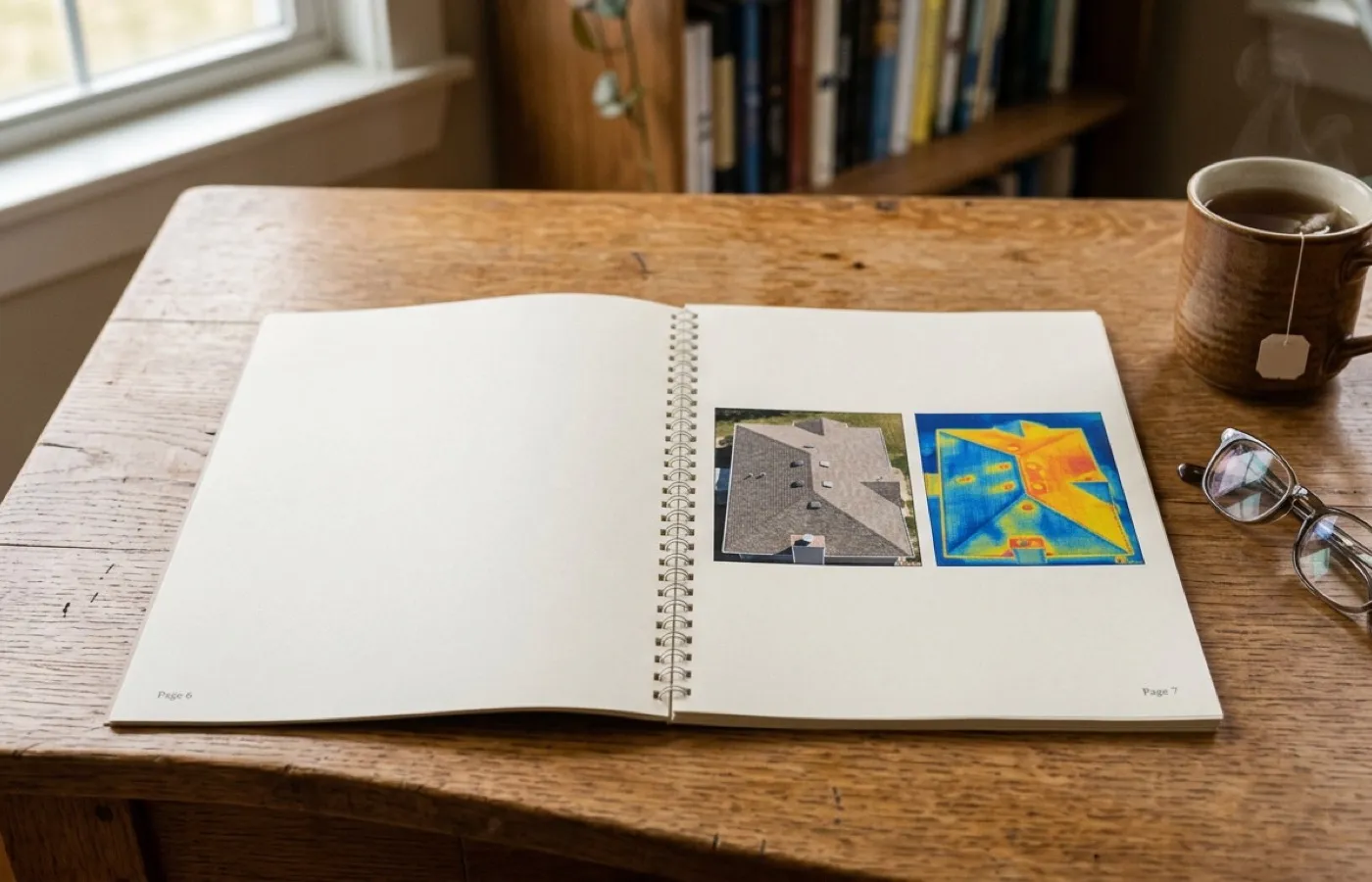
One clean frame per slope, so the roof can be understood as a whole before anyone starts looking at a single detail.
Thermal comparison
The same areas shown as a thermal reading, placed next to the visual image, so the two can be read together rather than as separate documents.
A view on the entry point
Where the evidence points clearly, the report names the most likely entry point. Where it does not, the report says that plainly rather than guessing.
Plain descriptions
What was found, where it is, and what it is likely to lead to. Written in words a homeowner can follow and a roofer will not roll their eyes at.
What could not be assessed
Anything obscured by vegetation, standing water or the conditions on the day is listed as not assessed rather than quietly left out.
The original files
Full resolution visual and thermal images, so whoever quotes the work can look at the same evidence rather than trusting a compressed screenshot.
Why 48 hours
Because that is how long the desk work takes when the visual and thermal images are actually compared properly, rather than filed alongside each other unread. If a trace is tied to an insurance deadline or a booked repair, say so when you book and it gets scheduled around it.
Weather and rules
The bits that decide whether a trace happens today
Wind
Above roughly 20 miles an hour the aircraft is working hard enough that image stability suffers, and gusts around a building are worse than the forecast suggests. A trace flown in marginal wind produces marginal imagery, so it moves instead.
Rain
Water on the lens ruins the frame and standing water on the roof hides exactly the pattern the thermal camera is there to find. Actual rain grounds the flight, but a booking shortly after rain has passed can give the thermal pass more to work with, not less.
Light and timing
Thermal contrast is clearest before the sun has warmed every slope to much the same temperature, so early mornings tend to hold on to more difference than a warm afternoon. The visual pass prefers bright overcast, so the two are balanced against each other when a slot is booked.
Airspace
Some addresses sit inside a flight restriction zone around an aerodrome or under other restricted airspace. That is checked before booking. Where permission is needed it gets sought, and where a flight cannot happen at all you are told before you have paid anything.
What is underneath
The A2 Certificate of Competency allows closer operation near buildings and uninvolved people than the basic category, which is what makes town centres and terraces workable. It still means thinking about the pavement below and the neighbours either side.
Rescheduling
Moving a trace for weather or light is normal and costs nothing. It happens most winters and it is better than flying a job that produces imagery nobody can actually read anything into.
Before you book
Common questions
- How does thermal leak tracing actually work?
- Water sitting under a roof covering, or the material around it, holds and releases heat differently to dry material nearby. That difference shows up as a temperature pattern on a radiometric thermal camera, flown alongside an ordinary visual camera over the same roof. Comparing the two often narrows a leak down to one area or one detail rather than the whole roof.
- Will you definitely find where the leak is coming in?
- No survey method can promise that on every roof, and this one is not sold as if it can. Thermal contrast depends on the conditions on the day, how long the leak has been running, and what is under the covering. Where the imagery points clearly at an entry point, the report says so. Where it does not, the report says that too, plainly, rather than guessing.
- Does it matter if it has not rained recently?
- It helps if it has, because a wet patch reads more clearly on thermal shortly after rain than it does once everything has dried out and settled to the same temperature. If you can book reasonably soon after the leak has shown itself, or after the next rain, the trace has more to work with. It is still worth booking on a dry spell, it is just a different reading.
- Do I need to be there?
- No. Plenty of traces are flown for landlords, letting agents and managing agents with nobody on site. All that is needed is somewhere lawful to take off and land, and permission to be there. If you want to be present and watch the screen, that is welcome too.
- What if the weather turns?
- The flight moves. Rain on the lens ruins the imagery and strong wind ruins the stability, so a trace flown in bad conditions is not worth having. Rescheduling for weather costs nothing and is treated as normal rather than as a cancellation.
- Can you fly in a terrace or a town centre?
- Usually yes. The A2 Certificate of Competency covers flying closer to buildings and people than the basic category allows, which is what makes tight streets workable. Some sites are restricted by airspace or by what is directly below, and that is checked before the booking is confirmed rather than on the day.
- What do I actually get at the end?
- A written report within 48 hours, with the visual and thermal images side by side, a plain description of what was found and where, and the full resolution originals so your roofer or builder can look at the same evidence themselves.
- Is the report enough for an insurance claim?
- It gives an insurer or a managing agent dated, photographed and thermal evidence of where the water appears to be entering, which is usually what is asked for first. It is not a loss adjuster's assessment and does not price the repair, and the report says so rather than implying otherwise.
- Will you tell me what it costs to fix?
- The report describes what was found and how it looks. Pricing the repair is the roofer's job, and the images are there so they can quote from real evidence rather than a ladder, a torch and a guess.
- How much does a leak trace cost?
- It is a fixed price per trace, agreed before the visit, based on the address and the size of the roof. Send the address and what the leak has been doing and you get the figure back rather than a range.
Find the entry point first
Book a leak trace with Roof Leak Detection
Tell us the address and what the leak is doing. Sam Hembury will come back with a fixed price and the next available slot.